Detailed Description
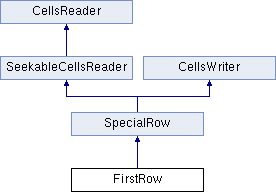
Class that reads and stores an Special Row considering a the affine gap formula in the first row.
This class is the implementation of a SpecialRow that considers the formula of the affine gap function in the first row. It does not need to store the cells in memory, since it can reproduce the cells using the affine gap formula.
This class works only in read mode. Thus, it contains many methods that does nothing, but we need to implement them since the abstract SpecialRow superclass contains virtual methods.
Definition at line 41 of file FirstRow.hpp.
#include <FirstRow.hpp>
Public Member Functions | |
| FirstRow () | |
| Default contructor. | |
| virtual | ~FirstRow () |
| Destructor. | |
| virtual void | close () |
| This method does nothing, but we need to implement it since the abstract SpecialRow superclass contains this virtual method. | |
| virtual void | truncateRow (int size) |
| This method does nothing, but we need to implement it since the abstract SpecialRow superclass contains this virtual method. | |
| void | setCellsReader (SeekableCellsReader *reader) |
| Defines the affine gap function parameters. | |
Private Member Functions | |
| virtual void | initialize (bool readOnly, int length) |
| This method does nothing, but we need to implement it since the abstract SpecialRow superclass contains this virtual method. | |
| virtual int | write (const cell_t *buf, int offset, int len) |
| This method does nothing, but we need to implement it since the abstract SpecialRow superclass contains this virtual method. | |
| virtual int | read (cell_t *buf, int offset, int len) |
| This method does nothing, but we need to implement it since the abstract SpecialRow superclass contains this virtual method. | |
Private Attributes | |
| SeekableCellsReader * | reader |
| the affine gap function parameters | |
Constructor & Destructor Documentation
Default contructor.
Definition at line 30 of file FirstRow.cpp.
| FirstRow::~FirstRow | ( | ) | [virtual] |
Destructor.
Definition at line 40 of file FirstRow.cpp.
Member Function Documentation
| void FirstRow::close | ( | ) | [virtual] |
This method does nothing, but we need to implement it since the abstract SpecialRow superclass contains this virtual method.
Implements SpecialRow.
Definition at line 55 of file FirstRow.cpp.
| void FirstRow::initialize | ( | bool | readOnly, |
| int | length | ||
| ) | [private, virtual] |
This method does nothing, but we need to implement it since the abstract SpecialRow superclass contains this virtual method.
Implements SpecialRow.
Definition at line 67 of file FirstRow.cpp.
| int FirstRow::read | ( | cell_t * | buf, |
| int | offset, | ||
| int | len | ||
| ) | [private, virtual] |
This method does nothing, but we need to implement it since the abstract SpecialRow superclass contains this virtual method.
Implements SpecialRow.
Definition at line 84 of file FirstRow.cpp.
| void FirstRow::setCellsReader | ( | SeekableCellsReader * | reader | ) |
Defines the affine gap function parameters.
- Parameters:
-
score_params the affine gap function parameters. firstRowGapped If true, the affine gap is used in the entire row (global or semi-global alignment scenarios). Otherwise, we consider that the first row if filled with zeroes (local alignment scenario).
Definition at line 77 of file FirstRow.cpp.
| void FirstRow::truncateRow | ( | int | size | ) | [virtual] |
This method does nothing, but we need to implement it since the abstract SpecialRow superclass contains this virtual method.
Implements SpecialRow.
Definition at line 61 of file FirstRow.cpp.
| int FirstRow::write | ( | const cell_t * | buf, |
| int | offset, | ||
| int | len | ||
| ) | [private, virtual] |
This method does nothing, but we need to implement it since the abstract SpecialRow superclass contains this virtual method.
- Returns:
- always zero.
Implements SpecialRow.
Definition at line 73 of file FirstRow.cpp.
Member Data Documentation
SeekableCellsReader* FirstRow::reader [private] |
the affine gap function parameters
indicates if the first row considers the affine gap function or not
Definition at line 82 of file FirstRow.hpp.
The documentation for this class was generated from the following files: